
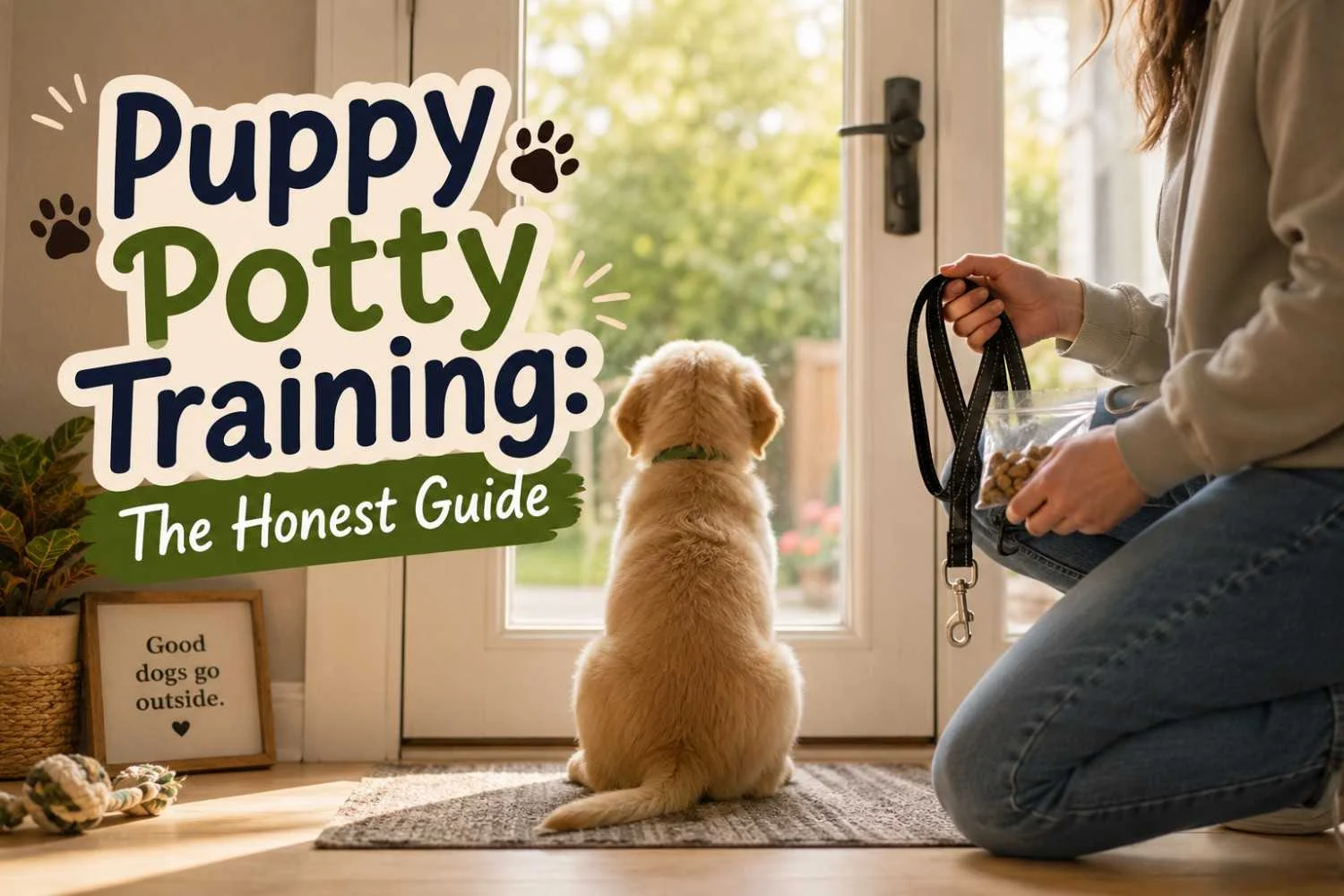
You bring home this tiny ball of chaos and everyone says “congrats!” but nobody
mentions you’re about to spend the next month staring at a small creature’s butt like
it’s a bomb about to go off. You blink, and suddenly you’re Googling “why is my
puppy peeing again, they JUST WENT.”
If you’re here, you love your dog, but you also like dry floors and sleeping longer than
3 hours at a stretch. Fair. This site is for people who actually live with dogs—not the
picture-perfect Instagram version, the real “why is there a wet spot on my sock”
version.
Puppy potty training can be simple, but it’s not automatic. It’s biology plus routine
plus you being slightly more organized than your usual self. The good news? There’s
a clear system. The bad news? You actually have to follow it. Let’s make that as easy
(and honest) as possible.
THE THING NOBODY ACTUALLY SAYS OUT LOUD

Here’s what glossy training blogs rarely say: you’re not “failing” puppy potty training
because you missed some magic command. You’re struggling because you’re trying
to fit a baby animal’s bladder into an adult human schedule.
Most puppies simply cannot “hold it” the way we wish they would. A common rule
trainers use: a puppy can hold their pee for about their age in months plus one hour,
max . So your three-month-old? Roughly four hours in perfect conditions. Not eight.
Not your entire lecture, shift, or Netflix binge. Four, if you’re lucky and they didn’t just
chug water.
Nobody tells you that “fully potty trained” usually means four to six months of
consistent work, and some dogs take closer to a year to become totally reliable in
every situation. Meanwhile social media acts like you can “potty train in seven days”
if you just buy the right pads, bell, course, or whatever. Puppy potty training is not a
hack; it’s a routine you grind through until it works quietly.
Here’s another unspoken truth: most of the accidents are on us, not the dog. You get
distracted, you think “it’s fine, she went an hour ago,” and then you’re suddenly
holding paper towels and questioning your life choices. Puppies do show
signs—sniffing, circling, wandering off to a quiet corner—but you only notice them
once you’ve cleaned up a few messes.
And yes, you will repeat yourself a lot. Same door, same spot, same cue word, same
ridiculous happy voice when they finally pee outside. It feels silly until you realize
your puppy is basically learning a bathroom religion: this door, this patch of grass,
this word, this feeling = relief + reward. Everything else = confusing.
The “dirty little secret” trainers already know: most people give their puppies too
much freedom, too soon. You let them roam the whole house because it feels kind,
but they just see more carpet to experiment on. Crates, pens, baby gates they’re not
punishment, they’re how you keep mistakes from becoming habits.
Think of it like that one sitcom character who always causes chaos when left alone
with open access to everything. Your puppy is that character. The house isn’t “home”
yet, it’s a maze of possible toilet spots. You’re teaching them the map one square at
a time.
And yes, one more thing people say quietly: you will get annoyed at some point. You’ll
be tired and you’ll want to yell. Don’t. Punishing for accidents doesn’t make them
learn faster; it just makes them hide it better or get scared to go in front of you. So
the real game is this: manage, prevent, reward, repeat while you mumble “I chose this
life” under your breath at 3 am
HOW THIS ACTUALLY WORKS THE REAL MECHANICS

Under all the tips and cute reels, potty training is just three things: biology, timing,
and associations. Your puppy’s bladder has a limited capacity, their brain is still
connecting “I feel pressure” with “I should move to my bathroom spot,” and you are
the slightly sleep-deprived scheduler in charge of making those two meet in the right
place.
Biology first.

Puppies can’t hold pee like adult dogs. Many experts suggest the
age‑in‑months‑plus‑one‑hour guideline, and even then only during the day. At night
they often last a bit longer, especially past four months, but in the early weeks you’re
taking them out a lot—first thing in the morning, after every nap, after meals, after
wild play, and last thing at night. That “every 2 hours” advice you see? It’s not drama,
it’s honestly about right at the start.
Then timing. If food and water go in on a schedule, pee and poop come out on a
schedule. Free‑feeding (leaving food down all day) makes their bathroom rhythm
random. Regular meals make it predictable, which is good for your floor and your
sleep. Most puppies need to go out 15-30 minutes after eating, and almost
immediately after waking up.
Associations are the part generic blogs often skip. You’re not just “taking them
outside.” You’re teaching: this door, this surface, this smell, this cue word, this feeling
of relief, followed by that little treat party = correct. Same spot each time helps; their
own scent tells them “oh, this is the toilet area.” A simple cue like “toilet” or “go potty”
said while they’re actually going eventually becomes a helpful command.
Here’s the niche angle almost nobody covers: signal training

for real-life humans who
aren’t staring at their dog 24/7. If you ring a bell every time you take your puppy out,
or help them paw a doorbell button, they can learn to ring it when they need to go.
That’s how students, people living with parents, or busy remote workers stop playing
“guess the pee time” and get a clear notification system.
Five real-world mechanics people underestimate:
● Crate and small‑space magic: Dogs are less likely to pee where they sleep, so
using a correctly sized crate or a small gated area helps them learn to hold it
between trips outside. Too big, and they just pick a corner and go.
● Supervision is a skill, not a vibe: “Keeping an eye” on your puppy doesn’t work
if you’re on your phone. Many trainers suggest tethering the puppy to you with
a leash indoors so you actually see the sniff-circle-squat combo before it
happens.
● Cleaning is part of training: If you don’t clean accidents thoroughly, the leftover
smell is basically a glowing “pee here again” sign. Enzyme cleaners aren’t just
marketing; they literally break down the odor in a way normal floor cleaner
doesn’t.

● Reward timing matters: Praising them when you come back inside is useless.
The treat needs to arrive while they’re finishing or right after they finish
outside. That’s how their brain links “pee here” with “good things happen.
● Access is earned: Big mistake is giving the whole house too early. Most
shelters and trainers suggest opening up new areas only after a couple of
accident-free weeks in the current area. You’re unlocking rooms like levels in a
game.
Once you understand those mechanics, the whole thing feels less like chaos and
more like a pattern you’re training both of you into.
COMPARISON WHAT’S ACTUALLY DIFFERENT
BETWEEN YOUR OPTIONS
Main potty training methods
| Option | What it actually does | Who it’s for | The catch |
|---|---|---|---|
| Outdoor-only training | Teaches puppy to toilet only outside on grass or ground | People home often, with safe outdoor access | Needs frequent trips outside; difficult in apartments or bad weather |
| Indoor pads / paper | Gives puppy a “legal” toilet spot inside using pads or newspaper | High-rise living, long work hours, tiny puppies | Can be difficult to transition from pads to outdoor toileting later |
| Crate-based house training | Uses a crate and strict schedule so the puppy holds it and goes outside during breaks | People who can follow a schedule and want faster reliability | Needs the correct crate size and consistency; cannot be used as punishment |
| Balcony / potty box systems | Uses a litter box or grass patch on a balcony or inside as a semi-outdoor bathroom | Apartments with balconies, small breeds, bad-weather areas | Requires regular cleaning; some dogs still need to transition outdoors later |
| Mixed method (pads + yard) | Combines an indoor spot for emergencies with regular outdoor potty trips | Students, shift workers, families with changing routines | Can confuse some puppies if not phased out carefully |
If you can manage it, I recommend outdoor‑only or crate‑based house training for
clear, long‑term habits; it’s simpler for the dog and fewer mixed signals for you. If you
live in a flat or can’t get out often, pads or a balcony/potty box make sense—but plan
from day one how and when you’ll transition to whatever “adult routine” you actually
want.
WHAT ACTUALLY HAPPENS WHEN YOU TRY THIS

When you actually start, day one feels cute. Tiny harness, little sniff around the grass,
you say “go potty” in a hopeful voice. By day three, you’re in track pants at 6 am,
holding a treat bag, chanting “come on, just pee” while your puppy eats a leaf and
forgets why they’re outside.
In real life, the pattern often looks like this: first week, chaos with a few wins. Second
and third weeks, you start seeing a rhythm after food, after naps, every couple of
hours. Around week four and five, you realize, “oh, we haven’t had an accident in a
few days.” Then, just when you get cocky, something changes—weather, your
schedule, their teething and you get a random puddle again. That back-and-forth is
normal.
One thing that surprised me the first time: how fast puppies can go from “playing” to
“peeing.” There is very little warning at the beginning. They’ll be zooming around, then
suddenly they stop, sniff, squat, and you’ve got about two seconds to react. That’s
why those early weeks of watching them like you’re on security camera duty are so
intense—but also why you start spotting their personal tells: maybe yours circles, or
stares at the door, or wanders to the same corner every time.
A pattern most articles miss is the “false outside trip.” You stand in the garden for
ten minutes, freezing, nothing happens, you go back in, and they immediately pee on
the floor. This isn’t your dog trolling you (even if it feels like it). They got distracted
outside—too many smells, sounds, birds—and their body relaxed only when you
came back inside. The fix is annoying but simple: if they don’t go in five minutes, go
back indoors but keep them on leash or in the crate, then try again ten minutes later.
Another real-world thing: your energy matters more than you think. If you yell or
punish for accidents, many dogs don’t “learn not to pee inside”; they learn “don’t pee
when the human is around.” That’s how you end up with dogs that sneak behind
sofas or wait until you’re in another room. Calm clean-up, quiet interrupt, happy
praise outside—boring, but it works.
Most people also underestimate the mental load. You’re tracking meals, water, naps,
play, when they last went, and which door you used, all while doing your normal life. A
simple notes app or whiteboard with times can save your brain. You’re not just
training a puppy; you’re training your future self to stop guessing and follow the
pattern you already proved works.
THE ADVICE EVERYONE GIVES VS WHAT ACTUALLY
WORKS
“Just take them out every hour and they’ll get it.”
This pops up everywhere and sounds neat, but life isn’t an hourly alarm. An hour
might be too often for some puppies and not enough for tiny ones. The real pattern
is event‑based: after waking, after eating or drinking, after intense play, before bed,
plus reasonable gaps in between based on age. Instead of blindly following the
clock, watch what your actual puppy does over a couple of days and build a schedule
around their body, not a meme.
“Rub their nose in it so they learn.”
This is old-school and wrong. It doesn’t teach them where to go; it just tells them you
are scary near pee. Many humane organizations and vets are very clear: punishment
for house‑soiling slows training and can create anxiety. The grounded alternative is
boring but real—interrupt gently if you catch them mid‑accident, take them to the
right spot, praise if they finish, and clean up properly with enzyme cleaner.

“Puppy pads are bad, only train outside.”
Pads aren’t evil. They’re a tool. For someone on the 12th floor or in a city where 2 am
walks are not safe, indoor pads or a potty box may be the only sane option. The
problem is not pads; it’s never planning the transition. If you want an outdoor‑trained
adult dog, you can start with pads in a fixed location, then gradually move them
closer to the door, then just outside, then onto grass. It takes effort, but it absolutely
works.
“Crates are cruel, just let them roam.”
A crate used wrongly is cruel. A crate used right is a den, a safe little bedroom, and
one of the fastest ways to build good toilet habits. Dogs usually avoid soiling where
they sleep, so a properly sized crate helps them hold it between trips as long as
you’re not leaving them for too long. Letting a not-yet-trained puppy roam a full house
is like giving a toddler unsupervised access to paint and then acting shocked about
the walls. A realistic middle ground: short crate naps, play in a small pen or tethered
to you, outside breaks often, and zero using the crate as punishment.
The pattern across all this? Viral advice loves extremes. Real puppy potty training
lives somewhere in the middle, where you respect the dog’s body, protect your floors,
and pick tools that match your actual lifestyle, not someone else’s.

THE PRACTICAL PART WHAT TO ACTUALLY DO
- Set up a tiny “world” on day one.
Decide where your puppy sleeps, where they eat, where they play, and where
they pee. Use a crate or a small gated area for naps and night, a pen or a
small room for play, and choose one outdoor (or pad) spot as the bathroom.
The smaller and clearer their world is at first, the fewer “oops, I thought this
rug was grass” moments you’ll have. - Run an event-based potty schedule, not guesswork.
For the first couple of weeks, take your puppy to their toilet spot: first thing in
the morning, after every nap, 10-30 minutes after meals, after crazy play, and
right before bed. Add regular daytime gaps based on age (eg, every 1.5–2
hours for very young pups). Use the same door, walk them on a leash, stand
still, say your cue when they start going, and reward immediately when they
finish. - Supervise like a low‑budget security system.
When they’re out of the crate or pen, you’re watching them. Not kind of
watching. Actually watching. If you can’t, tether them to you with a leash or
pop them back in their safe area. The second you see sniffing, circling, or that
“I’m searching for a quiet corner” energy, calmly take them to their spot. This
is where you prevent half the accidents instead of cleaning them. - Interrupt accidents, don’t freak out.
If you catch them mid-pee, don’t shout. Say their name, make a neutral noise,
or clap once, then scoop them up or walk them quickly to their toilet area. If
they finish there, praise and treat. If you find a cold puddle later, just clean it
with enzyme cleaner and move on—no lectures, they literally won’t connect it. - Teach a clear “I need to go” signal.
Hang a bell by the door or use a button. Every time you take them outside,
help them ring it, then immediately go out. After enough repeats, many
puppies start ringing it themselves when they feel the urge. Yes, they might
ring for fun at first. You’ll refine it. But having a clear signal beats “mysterious
pacing” any day. - Log three days and adjust from data.
For 72 hours, note when they eat, drink a lot, nap, pee, poop, and have
accidents. You’ll see patterns maybe they always need to poop 20 minutes
after breakfast, or every play session triggers a pee. Adjust your schedule to
hit before those moments and suddenly you look like a genius, but you’re just
following their biology. - Phase in freedom slowly.
Once they’ve had 2–3 weeks with no accidents in their small area, unlock one
more room. Keep supervising, repeat the process. If accidents start again, roll
back access and tighten the schedule. Freedom is a reward for reliability, not
a starting point.
QUESTIONS PEOPLE ACTUALLY ASK
How long does it really take to potty train a puppy?
Most puppies take around four to six months to be reliably potty trained in a normal
home, with some needing closer to a year to be totally solid in every situation. You’ll
usually see improvement after the first few weeks if you’re consistent, but random
accidents can still happen during growth spurts, routine changes, or illnesses. The
key is steady progress: fewer accidents, longer gaps, clearer signals. If nothing is
improving after a month of actual effort, it’s time to tweak your setup or talk to a
trainer or vet.
How often should I take my puppy out to pee?
A common rule is age in months plus one hour as the maximum daytime gap, but
many people need to go out more often at first. Most experts suggest taking young
puppies out at least every two hours, plus after every meal, nap, and play session.
Nighttime is different—after about four to six months, many puppies can sleep
through the night without a break, but younger ones usually need at least one trip. It’s
better to go out slightly too often early than to keep cleaning the same carpet.
Why does my puppy pee inside right after coming back from outside?
This annoying move usually means your puppy got distracted outside and didn’t fully
relax enough to go. New smells, sounds, other dogs, and people can be more
interesting than their bladder. When you come back inside, they finally chill and…
there it is. The fix is structured trips: go to the same quiet spot, stand still, give them
5 minutes, then if nothing happens, bring them in but keep them on leash or crated
and try again in 10 minutes. It’s repetitive, but it teaches “we’re out here for a reason,
not a sniff party.”
Should I use puppy pads or go straight to outdoor potty training?
If you have easy outdoor access and are home enough, going straight outdoors
creates a very clear rule for your dog: bathroom is outside, full stop. If you live in an
apartment, extreme weather, or have a schedule that makes constant trips
impossible, pads or an indoor potty area are a practical bridge. The trick is to choose
your end goal early. If you want an outdoor dog later, plan a gradual
pad‑to‑door‑to‑outside transition instead of just hoping they’ll “figure it out.”
Is crate training necessary for potty training?
Not strictly, but it’s very helpful for many households. Crates tap into a dog’s natural
tendency not to soil their sleeping area, so they’re great for teaching “hold it until we
go to the bathroom spot,” as long as you don’t stretch that hold too long. If used
well—with the right size, comfy bedding, toys, and short sessions—they’re more like a
bedroom than a jail. You can potty train without a crate using pens and constant
supervision, but it usually requires more human energy and better timing.
What should I do if my puppy keeps having accidents in the same spot?
That spot smells like “toilet” to your puppy now, even if you can’t smell it. First, clean
it with an enzyme‑based cleaner that breaks down the odor deeply, not just a general
floor cleaner. Second, block access to that area for a while—use a gate, move
furniture, close the door, or keep them on a leash. Then tighten your schedule and
supervision so they have fewer chances to rehearse that habit. If it’s a rug,
sometimes the smart choice is just rolling it up for a few months.
Is my puppy being stubborn or is this normal?
Most of the time, this is normal, not stubbornness. Puppies live in the moment;
they’re not plotting against your mop. If accidents are frequent, it usually means one
of three things: the schedule is too loose, supervision is too relaxed, or there’s a
medical issue like a urinary infection. If you’ve tightened the routine, reduced
freedom, cleaned properly, and things still seem off, a vet check is smart. Treat
“stubborn” as “something in the system isn’t matching this specific dog yet,” not as a
personality flaw.
Can I potty train a puppy while working full time
Yes, but not without help or adjustments. A young puppy simply cannot hold it for a
whole work day, no matter how good your intentions are. If you work full time, you’ll
need a midday helper—friend, neighbor, dog walker or a clear indoor potty solution
like pads or a potty box that you accept as part of the plan. Crating a tiny puppy 8–9
hours and hoping for the best usually ends with soiling in the crate, which is the
opposite of what you want them to learn.
READ MORE:Most Expensive Dog Breeds and TheirLifetime Costs (So You Don’tAccidentally Adopt a Walking EMI)
SO WHERE DOES THIS LEAVE YOU?
So yes, puppy potty training is a little messy, a little tiring, and not remotely as
“instant” as the internet likes to pretend. You’re basically running a small bathroom
experiment on legs, and the test subject eats socks. But it is also one of the clearest,
most winnable dog problems you’ll ever work on—because the rules are simple once
you accept them.
You now know the core pattern: limit freedom, follow an event-based schedule, use
one clear toilet zone, reward the right moments, and clean the wrong ones like a
crime scene never happened. There will be accidents. There will be 6 am stand‑offs
in the rain. There will be days you wonder if you adopted a tiny camel with a
vendetta. And then, one day, you’ll realize they walked to the door and waited for you.
If you do one concrete thing today, set up your puppy’s world: define their sleep area,
pen or small room, toilet spot, and the exact times you’ll take them there for the next
48 hours. Don’t aim for perfect, aim for consistency. It won’t be magic, and it won’t be
instant, but it will be progress you can actually see and that’s how this goes from
“help” to “handled.”
You made it all the way down here, which probably means you care more about this
dog than half the people you follow online. Respect. Potty training isn’t glamorous
work; nobody’s posting cute reels of 3 am backyard trips in pyjamas. But this is the
part that quietly decides whether living with your dog feels peaceful or chaotic.
If you take nothing else from this, remember: your puppy isn’t being difficult, they’re
being young. Your job isn’t to demand perfection; it’s to build a system where good
habits are the easiest option for both of you. The messes will fade, the routine will
become invisible, and one day the only thing you’ll remember is that weird phase
where you celebrated pee like it won an award.


Pingback: Dog Training Basics: Essential Commands Every Dog Should Learn