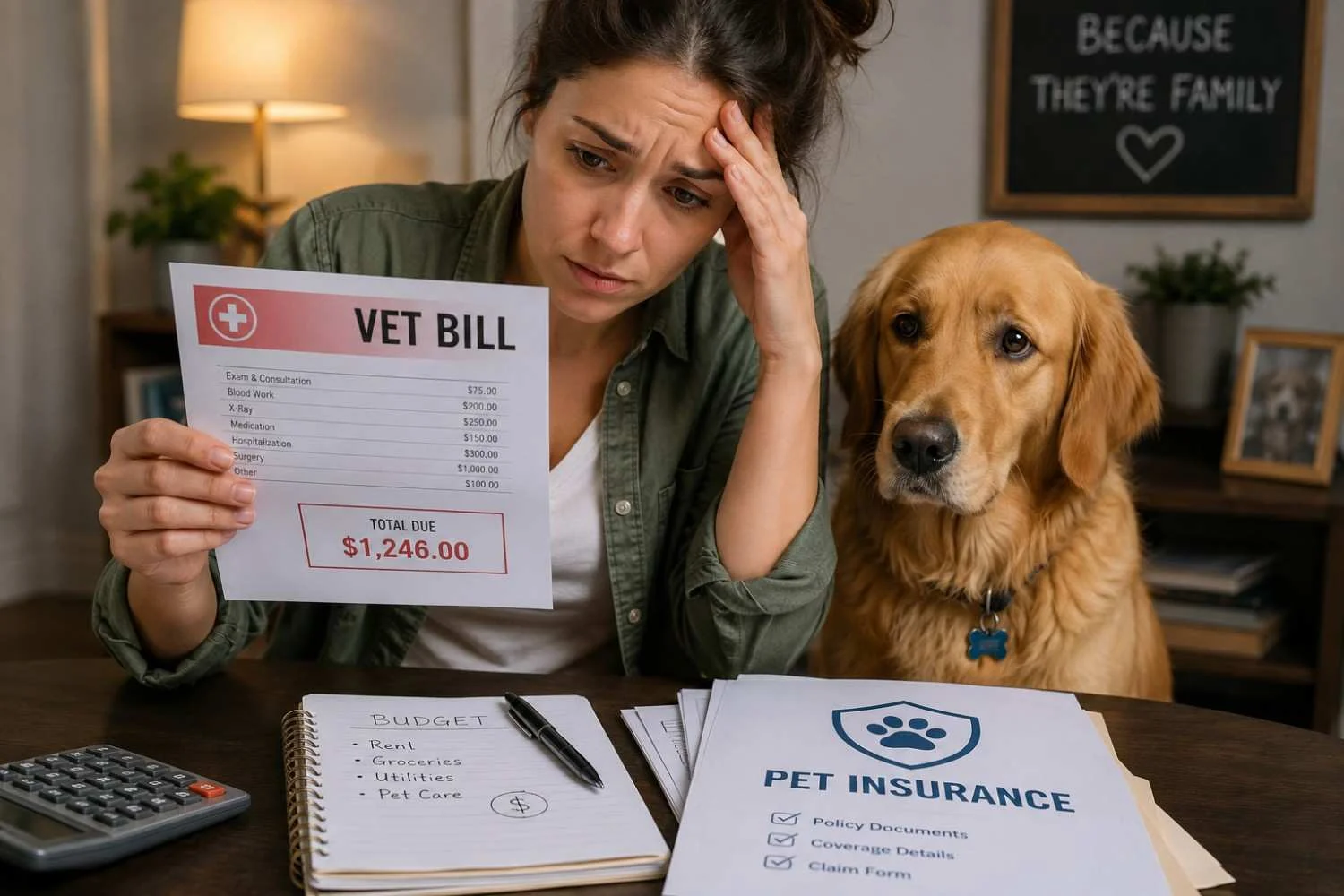
Picture this.
Your dog throws up twice, looks sad in that “something is wrong” way, and suddenly
the vibe in the room shifts from “aww” to “oh no.” You’re on the floor with Google in
one hand and a credit card in the other.
This site exists for dog people who actually live like humans. Students. First-job
zombies. People splitting rent and pretending instant noodles are a “choice.” We talk
dogs, not as Pinterest mood boards, but as living, chewing, occasionally-vomiting
creatures that collide with real-world money.
Here’s the quiet reality.
Routine vet visits for dogs sit around 70 to 174 dollars in many places, and a proper
emergency can explode into 2,000 to 5,000 dollars in one go. Dog insurance, on the
other hand, often costs roughly 52 to 62 dollars a month for accident-and-illness
plans, depending on the brand and coverage you pick.

So the question isn’t “Is dog insurance good?”
The question is “Does it make sense for you to trade that monthly hit for not
completely falling apart when life throws a medical plot twist at your dog?”
READMORE:How Much Does Dog Insurance Cost in2026 (Without Sugarcoating It)
THE THING NOBODY ACTUALLY SAYS OUT LOUD
Here’s what people don’t admit: dog insurance is basically emotional outsourcing.
You’re not just buying coverage. You’re buying the ability to say “Do it” in the exam
room without doing mental algebra on your overdraft.

Most articles politely hover around this, but let’s call it what it is.
If a vet dropped a 3,000-dollar emergency surgery quote on you tomorrow—which is
a very normal range for serious cases—you’d either pay, borrow, beg, or walk away.
Only one of those options lets you sleep at night.
Meanwhile, the numbers quietly stack in the background.
Average accident-and-illness dog insurance runs around 52 to 62 dollars a month,
according to multiple analyses and NAPHIA data. Accident-only plans can be
cheaper, closer to 16 dollars a month, but cover far less. The global pet insurance
market itself is out here flexing with valuations around 9.8 to 21.8 billion dollars in
2025 and a projected climb to tens of billions by 2033.
Translation: enough people got wrecked by vet bills that this became a full-blown
industry.
Here’s the part nobody puts on the landing page:
If you’re 18 to 25, you are the exact demographic most likely to feel the cost of
insurance and least likely to have spare cash sitting around. You’re juggling tuition,
rent, maybe family obligations, and now a furry creature that can swallow socks for
fun.
And yet, you’re also the one sitting on the time window where insurance hits hardest.
The earlier you insure, the more coverage you can get before “pre-existing condition”
becomes the phrase that ruins your claim. The system rewards early, boring
decisions and punishes late, panicked ones. Classic.
Dog insurance is “worth it” if saying yes to treatment matters more to you than
hating another subscription.
You see this tension play out every day. Someone on social posts a vet bill, another
person comments “This is why you get insurance,” and someone else replies “This is
why you build savings.”
Both think they’re right. Both are missing context.
Real talk: most people don’t have perfect emergency funds.
Most people are not doing zero-based budgets in Notion while sipping herbal tea.
They’re ordering food at 11:30 p.m. and telling themselves it’s the last time. This
time.
Dog insurance lives inside that chaos. It’s not about being moral or “responsible” in
some Instagram productivity way. It’s a tool. Like a helmet. Or a backup charger. You
can live without it. Right up until the moment you really, really wish you hadn’t.

Think of it like health insurance in every high school teen drama. Nobody cares about
it until the serious episode where someone gets hurt.
Then suddenly, “Do we have coverage?” becomes the only line that matters.
HOW THIS ACTUALLY WORKS THE REAL MECHANICS
Under the fluff, dog insurance is pretty simple: you pay a company a monthly fee so
that when something expensive happens, they pay most of the bill instead of you.
Mechanically, here’s how it plays out.
You pick a policy. It has a premium (monthly cost), a deductible (what you pay before
they start paying), a reimbursement rate (what percentage they pay back—often 70
to 90 percent), and an annual limit (the maximum they’ll cover in a year). Then your
dog gets sick or hurt, you pay the vet up front, submit the claim, and they send you
money later.

Accident-and-illness policies usually cover things like injuries, infections, cancer,
diagnostics, hospital stays, and surgery. Many plans reimburse for hospital stays,
emergency surgery that can run between 1,800 and 5,000 dollars, and even long,
expensive treatments like chemo. Accident-only policies slice out the illness side and
focus just on injuries, which is why they’re cheaper.
The niche angle nobody talks about enough?
Dog insurance isn’t one-size-fits-all; it hits differently depending on which “life
combo” you’re playing on hard mode:
● Young owner + young dog
● Young owner + older rescue
● Low income + high-risk breed
● Stable income + chronic-condition dog
Each combo changes whether the premiums feel like “manageable protection” or
“slow drain.”
Here’s a short list with actual opinions, not brochure speak:
- Accident-and-illness for young dogs.
This is the sweet spot. Your dog is still healthy on paper, so the insurer covers
more now and in the future. If something big happens, your 52–62 dollar
monthly premium can save you thousands in emergency costs. - Accident-only if money is razor-thin.
It won’t help with cancer or chronic disease, but it can save you from disaster
if your dog is hit by a vehicle or eats something deadly. It’s not ideal. It’s still a
realistic step up from “hope and vibes.” - High-deductible plans for people with some savings.
If you can handle 500 to 1,000 dollars out of pocket, choosing a higher
deductible can chop your premium. You’re basically saying, “I’ll cover medium
chaos, you cover the huge stuff.” - Wellness add-ons as “forced budgeting.”
Wellness add-ons often cover routine care like vaccines and checkups. On
paper, they rarely save money. But if you know you’ll never save for annual
visits, they can act like a subscription-based nagging parent that forces you
into regular vet care. - Opting out and self-insuring.
You skip insurance and instead set aside a fixed amount monthly, hoping to
hit a buffer before disaster. This works great in spreadsheets. In real life, one
early 2,000–5,000-dollar emergency can blow that fund before it exists. You’re
gambling on timing.
Most generic blogs ignore this: dog insurance is less about “Is it good?” and more
about “Does it match the kind of bad luck you’re willing to risk?”
Once you accept that, the mechanics stop feeling mystical and start looking like
what they are: sliders. You adjust cost, coverage, and risk until it matches your real,
imperfect life.

COMPARISON WHAT’S ACTUALLY DIFFERENT
BETWEEN YOUR OPTIONS
Here’s the table you wish existed the last time you doom-scrolled comparison sites.
| Option | What it actually does | Who it’s for | The catch |
|---|---|---|---|
| Full accident-and-illness plan | Covers injuries, illnesses, surgeries, hospital stays, diagnostics; reimburses most big costs | Young or mid-age dogs, owners who want broad protection | Costs more per month; pre-existing conditions excluded |
| Accident-only insurance | Covers emergencies like fractures, car injuries, poisoning; cheaper premiums | Very tight budgets, high-risk or very active dogs | No coverage for illness, chronic disease, or many “slow burn” problems |
| High-deductible, lower-premium plan | Cuts monthly cost by making you pay more upfront per incident | Owners with some savings and stable income | You must have cash ready when something big happens |
| No insurance, savings only | You self-fund vet care, from routine to emergencies | Very disciplined savers or higher-income households | One early emergency (2,000–5,000 dollars) can wipe you out fast |
If you’re 18 to 25 with a young dog and not a lot of savings, I’d usually pick a
mid-range accident-and-illness plan with a reasonable deductible.
If you’re truly broke but your dog is a chaos gremlin, accident-only can still be better
than nothing—just don’t pretend it’s the same thing as full coverage.
WHAT ACTUALLY HAPPENS WHEN YOU TRY THIS
Here’s the version you don’t see in glossy marketing photos.
You sign up for a plan. Maybe 50-ish dollars a month, 80 percent reimbursement,
500-dollar deductible, 5,000-dollar annual limit. You feel slightly responsible and
slightly annoyed. The confirmation email hits your inbox. Then… nothing. Life goes
on.
First month, the premium hits right next to rent and phone. You grumble.
Third month, your dog eats part of a kitchen towel. There’s vomiting. There’s
late-night anxiety. You go to the emergency vet. The exam is 100 to 150 dollars.
Blood work adds 80 to 200. Imaging costs maybe 150 to 600, depending on what
they do. By the time you’ve paid for meds and a few hours of observation, the bill is
hovering around 800 to 1,500 dollars.

At that moment, two things happen.
One, you feel a weird mix of anger, relief, and “I should really get better at saving.”
Two, you remember you have insurance.
You pay the bill with a card you don’t love using.
When you file the claim, you send photos of invoices, answer questions about when
symptoms started, and wait. This waiting part is the bit nobody dramatizes, but it’s
real. You check email more than you checked exam results. When the
reimbursement finally lands, maybe they cover 80 percent of the amount above your
deductible.
You scroll the numbers.
You realize that without the plan, that month would have wrecked you. With it, you
still had stress, but not “should I even have a dog” stress.
One thing that surprised me the first time? How much behavior shifts after a single
big claim. You start noticing:
● You don’t delay care “until payday” as much because you know
reimbursement is coming.
● You stop saying “It’s just a dog” in your head when a vet suggests a test; you
actually listen.
● You quietly start respecting the boring details. Deductibles, annual limits,
exclusions—things you would’ve scrolled past now feel personal.
Here’s the pattern most articles skip: insurance rearranges your anxiety, it doesn’t
delete it.
Without insurance, your fear spikes at the moment of the bill. With insurance, your
fear spreads out into monthly payments and occasional paperwork. It’s swapped
panic for bureaucracy.
You also learn little things only people who’ve done this notice:
● Some vets are veterans at filling insurance-friendly invoices; others write
chaos. You start favoring the former.
● You see how often claims get partially denied because something was
labelled “pre-existing” or “not covered by policy”. Suddenly, you understand
why starting earlier was such a big deal.
● You realize that as your dog ages, premiums creep up because the risk creeps
up. There’s no free lunch here.
Most people find that insurance feels most “worth it” the first time a bill crosses
roughly 1,500 to 2,000 dollars.
Before that, it can feel like overkill. After that, it feels like a decent trade less like a
luxury, more like an ugly but useful piece of adulthood.
THE ADVICE EVERYONE GIVES VS WHAT ACTUALLY
WORKS
Let’s dissect some fan-favorite takes.
1.“Dog insurance is always worth it.”
Why it’s wrong or incomplete: If your dog is already old with multiple diagnosed
conditions, many policies will exclude exactly those issues as “pre-existing”. You
might pay hundreds or thousands over a few years and barely see any meaningful
coverage.
What actually works: For older dogs or rescues with known issues, run a quick
scenario. Look at what new problems might still be covered and compare that
against the premium plus your ability to pay out-of-pocket. Sometimes, accident-only
plus a focused savings plan gives more realistic value than a full plan with a wall of
exclusions.
2. “Just self-insure; it’s always better.”
Why it’s incomplete: Self-insuring assumes you start saving now, nothing big
happens for a while, and you’re disciplined enough not to dip into that fund for other
crises. Yet a single emergency surgery or hospitalization—often 2,000 to 5,000
dollars—can show up early and blow that fund into dust. Many people only start
saving seriously after their first scare, not before.
What actually works: A hybrid approach. Put a small, consistent amount into a “dog
emergency” pot each month and pair it with a mid-tier policy so the fund handles
deductibles and smaller stuff while insurance catches catastrophic bills.
3. “Always pick the cheapest plan; you’re young.”
Why it’s risky: The cheapest plans often mean low annual limits, low reimbursement,
or accident-only coverage. You’ll feel very clever until a long-term illness shows up
and the plan taps out halfway through, leaving you with both premiums and big bills.
What actually works: Start with what you’d struggle to pay alone—a 2,000-dollar
emergency, repeated tests, chronic meds—and work backwards from there. Choose
coverage that can realistically handle at least one serious emergency per year, not
just minor chaos.
4. “Don’t bother, hardly anyone has pet insurance.”
Why it’s lazy logic: Yes, penetration is still low compared to total pet ownership, even
as the global market hits around 9.8 to 21.8 billion dollars and is projected to grow
sharply over the next decade. That doesn’t mean it’s pointless. It means most people
either can’t afford it, don’t understand it, or are gambling.
What actually works: Treat other people’s choices as data, not destiny. Look at what
you personally could afford if an emergency vet bill landed tomorrow. If the answer is
“not much,” insurance becomes more relevant, not less.
Stripping out the noise, the advice that survives is simple:
Don’t copy someone else’s setup. Weigh your dog’s risks, your income, and your
tolerance for chaos, then pick the mix of insurance and savings that gives you the
best chance at saying yes when treatment actually matters.
THE PRACTICAL PART WHAT TO ACTUALLY DO
Here’s how you turn “I should think about this” into something that exists outside
your brain.
- Audit your worst-case scenario.
Write down your dog’s age, breed, and any known health quirks. Then look at
common emergency vet costs: exams at 100–150 dollars, imaging at 150–600,
hospital stays 2,000–3,500, and emergency surgery 2,000–5,000 dollars. Ask
yourself, bluntly: “What’s my actual upper limit if this happened next month?” That
number matters more than any marketing tagline. - Check what’s already in your safety net.
Do a realistic scan of savings, credit limits, and family support. If one unplanned
1,500–3,000-dollar bill would make you default on something important, you’re in the
danger zone. Dog insurance starts to look less like “extra” and more like “seatbelt.” - Get three real quotes based on your dog, not some example.
Go to three insurers that come up often in guides or that operate in your region. Enter
your dog’s actual age, breed, and location, and price accident-and-illness,
accident-only, and a mid-range plan. Screenshot or write the numbers
down—monthly cost, deductible, reimbursement, annual limit.

- Strip out the fluff.
When you compare those quotes, ignore the cutesy wellness add-ons for a moment.
Focus on the big stuff: emergency care, surgery, hospitalization, chronic conditions.
This is where your risk actually lives. You can always add wellness later if you want
forced routine-care budgeting. - Choose one realistic coverage profile.
Pick a combination that fits your current life: maybe 70–80 percent reimbursement, a
deductible you could pay in one bad month, and an annual limit that could handle at
least one major event (5,000 dollars or more). If the monthly premium feels painful,
tweak the deductible, not the entire coverage category. - Start now, not after the next vet visit.
Most insurers exclude pre-existing conditions, which means anything already in your
dog’s file is fair game to deny. Activating a policy before your next check-up gives
you a better shot at broad coverage. Waiting until “things calm down” is usually code
for “I’ll do it after it’s too late.” - Set a tiny automatic transfer as backup.
Even with insurance, you’ll face deductibles and uncovered bits. Set up an automatic
transfer—maybe 15 to 30 dollars a month—into a separate “dog chaos fund”. It
doesn’t have to be perfect. It just has to exist before the crisis does.
QUESTIONS PEOPLE ACTUALLY ASK
Is dog insurance really worth it?
It can be, especially if paying a sudden 2,000 to 5,000-dollar vet bill would wreck your
finances. For many owners, accident-and-illness plans that cost around 52–62
dollars per month trade predictable payments for protection from catastrophic
surprises. It feels most “worth it” when you face one or two big emergencies over a
dog’s lifetime. If you have strong savings and higher income, you might decide to
self-insure instead, but that’s a risk call, not a moral one.
How much does dog insurance usually cost per month?
Average accident-and-illness coverage for dogs runs roughly 52 dollars a month for
mid-range plans, and around 62 dollars based on some NAPHIA data. Accident-only
policies can drop to about 16 dollars a month because they cover fewer issues. Your
actual price depends on your dog’s age, breed, location, and the coverage levels you
pick. Expect to pay more for older dogs, high-risk breeds, and higher annual limits.
What does dog insurance typically cover?
Most accident-and-illness dog insurance covers vet exams related to covered
conditions, diagnostics like blood work and imaging, surgeries, hospital stays, and
prescription medications. Many plans also cover emergency care, which can run
thousands of dollars per incident. Routine care, like vaccines or dental cleanings, is
usually only covered if you buy a wellness add-on. Cosmetic or elective procedures
and pre-existing conditions are almost always excluded.
Does dog insurance cover pre-existing conditions?
No, most dog insurance plans do not cover pre-existing conditions, which are health
issues your dog had before the policy started or during the waiting period. Insurers
check vet records and can deny claims if they decide the problem was already
present. Some companies may reconsider certain conditions after a symptom-free
period, but that varies and is often limited. This is why starting earlier—while your
dog is still considered “healthy” on paper—gives you better coverage.
Is accident-only dog insurance enough?
Accident-only insurance can be a budget-friendly way to protect against injuries such
as car accidents, falls, or swallowing objects. It’s better than nothing if you’re on a
very tight budget and your dog has a risky lifestyle. However, it won’t help with
illnesses, cancer, allergies, or most chronic conditions, which are common reasons
for high vet bills. If you can stretch to accident-and-illness coverage, that usually
gives better long-term protection.
Is dog insurance worth it for older dogs?
It depends. For older dogs, premiums are higher and many policies exclude
pre-existing issues, so you might get less value for more money. However, if your
older dog is relatively healthy and at risk for expensive conditions like arthritis or
cancer, insurance can still cushion the blow. In some cases, a cheaper accident-only
policy plus a dedicated savings fund might be more realistic than a top-tier plan with
a long exclusion list.
Should I get dog insurance or just save money?
Both options can work, but they handle risk differently. Self-insuring by saving money
gives you full control but requires strong discipline and good timing; a big emergency
early on can wipe your fund before it grows. Insurance, on the other hand, spreads
that risk and can cover 70–90 percent of big bills, depending on your plan. Many
people find a mix works best: a reasonable policy plus a small emergency savings
buffer.
Is dog insurance worth it if I’m a student or on a low income?
If an unexpected 1,500–3,000-dollar vet bill would mean missed rent or debt,
insurance becomes more relevant, not less. You might not afford the fanciest plan,
but a basic accident-and-illness or accident-only policy can still protect you from the
worst scenarios. The key is picking coverage and deductibles that fit your actual
budget instead of pretending money isn’t a factor.
SO WHERE DOES THIS LEAVE YOU
You’re in the same place as most dog owners quietly are: stuck between “I never
want to say no to treatment” and “I can’t print money.”
The internet loves neat answers. Real life gives you trade-offs.
Here’s the reality. Vet care is getting more expensive, not less, and the pet insurance
market is growing because people are trying not to drown in those costs. Dog
insurance doesn’t magically fix that. It just changes how and when you feel the hit.
For some people, that trade is worth every cent. For others, it’s a bad fit.
So, one concrete thing you can do today: run three real quotes and compare them to
your actual bank balance, not your idealized future self. Decide whether you’re more
scared of the monthly premium or the emergency you can’t afford. That’s your
answer to whether dog insurance is “worth it” right now, for you, in this version of
your life.
You don’t have to get it perfect.
You just have to avoid being surprised in a way that hurts both you and your dog
more than it needs to.
You stuck around through the numbers and the uncomfortable questions. Respect.
Most people bail as soon as they sense a spreadsheet coming.
Dog insurance sits in that boring, annoying corner of dog ownership where adult
decisions live. It’s not fun. It doesn’t make cute Instagram content. But it can mean
the difference between “we handled it” and “I still think about that day” when things
go wrong.
If all you do after this is screenshot your top quote and text it to a friend saying,
“Should I actually do this?” that’s already progress. Real decisions rarely happen in
isolation they happen in messy group chats at odd hours.


Great content! Keep up the good work!